Strategic guide to selling high-risk: emerging verticals every ISO should watch
High-risk merchants were once viewed as difficult deals: hard to approve, complicated to support, and often more trouble than they were worth. Today, that perception is becoming outdated.
As underwriting frameworks mature, banking relationships expand, and payment technology becomes more sophisticated, many high-risk verticals are becoming more accessible than ever before.
For ISOs willing to develop expertise in these markets, the opportunity extends beyond simply placing hard-to-board merchants. High-risk often delivers larger account sizes, stronger residuals, and access to businesses that competitors are still overlooking.
The question is no longer whether high-risk is worth pursuing. The question is where the best opportunities exist and how to position your business for growth.
This guide covers where that opportunity is concentrated right now, why the usual objections to high-risk no longer hold up, and what it takes to build a high-risk portfolio that scales.
Key takeaways
- High-risk is growing faster than some traditional payments categories, and demand is expanding into verticals that were considered too complex to underwrite in recent years.
- Online pharmacy and alternative telemedicine, gaming, and money services businesses (MSBs) are among the fastest-growing categories.
- Many merchants previously considered difficult to place are becoming more accessible as underwriting and banking relationships evolve.
- Top-performing high-risk ISOs often share one common advantage: a processing partner with regulatory and compliance knowledge, underwriting expertise, banking relationships, and infrastructure needed to support complex merchant accounts.
Why high-risk growth is accelerating
Several market forces are driving growth across high-risk verticals.
First, digital commerce continues to expand into industries that historically operated offline or relied on alternative payment methods. Healthcare, gaming, financial services, and specialty retail categories have all experienced significant digital transformation.
Second, regulatory frameworks in certain sectors have become clearer, allowing banks and processors to evaluate risk more consistently than they could just a few years ago.
Third, advances in fraud prevention, chargeback management, risk monitoring, and underwriting technology have made it easier to support merchants that were once considered too operationally complex.
As a result, businesses that previously struggled to secure reliable payment processing are finding new opportunities to access traditional payment rails, and they're actively looking for partners who understand their needs.
What makes a merchant “high-risk”
Not all high-risk merchants are designated as such for the same reasons. Merchants are typically classified as high-risk because they operate in regulated industries, create future-delivery exposure, or experience elevated levels of chargebacks and friendly fraud. A high-risk designation does not mean a merchant or business model should be avoided. Instead, it signals the importance of partnering with a provider that has the underwriting expertise, compliance capabilities, and risk management infrastructure necessary to support the unique characteristics of the business.
Building a high-risk portfolio: Where to start
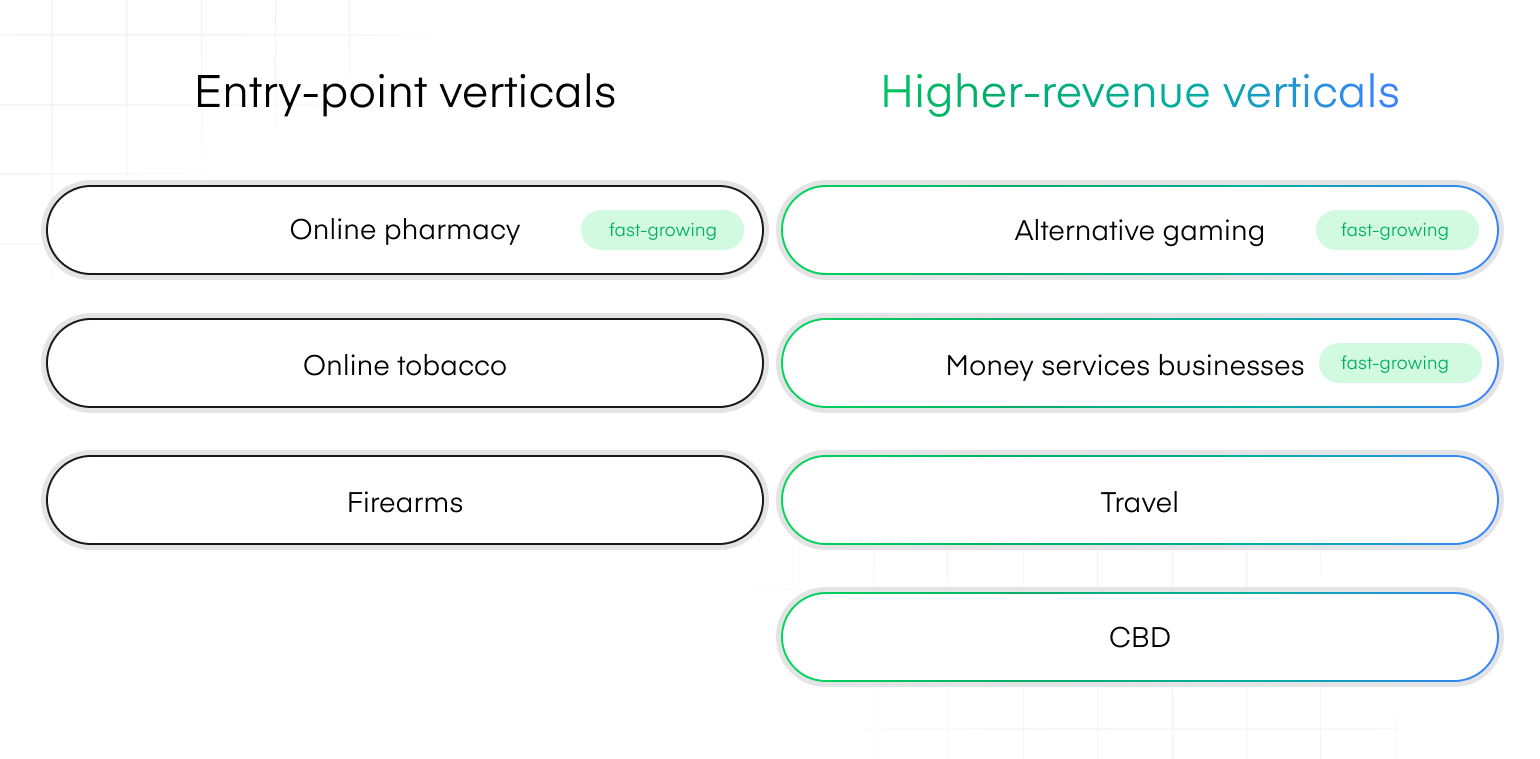
Not all high-risk categories require the same level of expertise or underwriting complexity. For ISOs looking to enter the space, the most effective approach is often to start with more accessible verticals, build experience navigating high-risk requirements, and then expand into higher-revenue categories as confidence and knowledge grow.
Good entry-point opportunities for new high-risk ISOs
Online pharmacy, online tobacco, and firearms often provide a practical introduction to high-risk processing.
While these industries still require proper compliance documentation and oversight, they often share characteristics with traditional card-not-present businesses, making them a practical way to gain experience in niche payments.
Expanding into higher-revenue categories
As familiarity with high-risk underwriting grows, many ISOs branch into verticals such as MSBs, gaming, travel, and CBD. These categories typically involve more specialized requirements, but often deliver larger processing volumes and stronger revenue opportunities.
The high-risk verticals to watch right now
While traditional high-risk categories remain important, several emerging sectors are seeing particularly strong demand.
Online Pharmacy
Online pharmacies and telemedicine platforms continue to expand as consumers become increasingly comfortable receiving care virtually and purchasing healthcare-related products online.
Although healthcare compliance and recurring billing considerations require careful attention, these businesses often represent one of the most accessible entry points into high-risk.
Alternative and Sweepstakes Gaming
Gaming continues to evolve beyond traditional sports betting and online casino models.
Sweepstakes-style and skill-based gaming platforms have experienced rapid growth, creating opportunities for processors capable of navigating state-by-state regulatory environments.
ISOs who understand the nuances of these business models are increasingly finding opportunities where generalist providers cannot compete.
Money Services Businesses
Money services businesses continue to generate significant payment volume as consumers increasingly look to specialized financial service providers for money remittance, foreign exchange, and digital wallet services.
While enhanced due diligence is required, many of these businesses have become substantially more bankable as regulatory expectations mature and risk controls have strengthened. Because these businesses operate within a highly regulated environment, they are typically well prepared to meet onboarding requirements, making the process far more straightforward than many assume.
For ISOs, these sectors represent a growing source of demand that many traditional providers still decline automatically.
Other emerging categories to watch
ISOs should also monitor growth in:
- Alternative financial services
- Subscription-based wellness brands
- Age-restricted products and services
- Online marketplaces
- Cross-border financial technology providers
As these sectors mature, many will create additional high-risk payment opportunities.
Revisit deals that were previously declined
One of the most overlooked opportunities in high-risk is sitting in many ISO pipelines already.
Businesses in verticals such as firearms, CBD, MSBs, and certain gaming categories that were declined several years ago may be viable candidates today.
Banking appetites change, underwriting standards evolve, and compliance programs improve. A past decline should not automatically be viewed as a permanent decline. ISOs who periodically revisit previously rejected opportunities often uncover revenue that competitors assume is unavailable.
Ready to build a high-risk portfolio that scales?
Start a conversation with our team of experts
What top-performing high-risk ISOs do differently
Many successful high-risk ISOs have one thing in common: they've built their business around partners and processes that can support complex merchants at scale. While no two portfolios look exactly alike, the organizations that consistently win in high-risk tend to share a handful of operational advantages that improve approvals, reduce risk, and create a better merchant experience.
They diversify banking relationships
ISOs that rely on a single banking relationship may find themselves limited to the types of merchants they can support. Successful organizations prioritize partners with multiple sponsor bank relationships that can accommodate a wider range of merchant profiles.
They streamline onboarding
High-risk merchants are often accustomed to lengthy applications and delayed decisions. Fast approvals, transparent requirements, and frictionless onboarding can create a significant competitive advantage and help improve conversion rates.
They integrate risk management early
Top-performing ISOs understand that risk isn’t something that starts after an account is approved. Chargeback prevention, fraud mitigation, and compliance planning should be part of the merchant conversation from the outset, helping create healthier portfolios over time.
They focus on long-term partnerships
The most successful organizations recognize that approval is only the beginning. Prioritizing ongoing support, compliance guidance, and account stability matter just as much as initial boarding.
They stay educated
High-risk markets evolve rapidly. Regulatory changes, emerging verticals, and new payment technologies can create new opportunities for ISOs that stay informed.
Common high-risk myths and the reality
Every ISO has heard the objections to high-risk, usually from someone who hasn't priced a deal in this space in years. Most of those objections are outdated, holding over from a time when underwriting, banking, and risk tools were nowhere near where they are today.
Before writing off a vertical or a deal, it's worth separating what used to be true from what's actually happening now.
The reality is that most objections to high-risk are not objections to the merchants themselves, but objections to inadequate infrastructure.
Choosing the right high-risk partner
Success in high-risk depends on far more than finding the right merchants. It depends on having the right payments infrastructure behind every deal.
When evaluating a processing partner, ISOs should prioritize:
- Direct access to experienced underwriting teams
- Multiple sponsor bank relationships
- Integrated gateway and ACH capabilities
- Efficient onboarding workflows
- Built-in fraud and dispute management tools
- Responsive support from teams that understand high-risk industries
A full-service provider that manages underwriting, risk, compliance, onboarding, and support internally is often best positioned to help ISOs scale efficiently and sustainably.
Maverick Payments has spent more than 25 years helping partners navigate complex payment environments. As a full-service payments provider, Maverick brings underwriting, risk management, compliance, onboarding, and support together under one roof. This integrated approach helps ISOs move opportunities from application to approval more efficiently while providing the infrastructure needed to support long-term portfolio growth.
Have the merchants. Need the infrastructure?
Start a conversation with Maverick Payments.
Conclusion
High-risk is no longer a niche corner of the payments industry. It has become one of the most significant growth opportunities available to ISOs today.
As emerging verticals continue to evolve and become more accessible, ISOs that understand these markets will be better positioned to uncover new revenue opportunities and expand their portfolios.
The organizations that see the greatest success will stay informed, remain compliance-focused, and align themselves with partners capable of supporting the full merchant lifecycle. For those willing to invest in that approach, high-risk isn't simply another category. It's a powerful growth strategy.
FAQ
Is high-risk still difficult to sell?
Many of the traditional challenges associated with high-risk have become more manageable thanks to advances in underwriting, risk management, and payments technology. With the right processor and support structure in place, many high-risk opportunities are more accessible today than they were just a few years ago.
Which high-risk verticals should ISOs target first?
ISOs entering the high-risk space should consider starting with online pharmacy, online tobacco, and firearms. These categories can offer a practical introduction to high-risk underwriting while helping build the experience needed to expand into more complex verticals.
What high-risk industries are growing the fastest?
Online pharmacy, gaming, and money services businesses are among the fastest-growing high-risk categories. As these continue to evolve, demand for specialized payment solutions is expected to grow alongside them.
Are previously declined high-risk merchants worth revisiting?
Yes. Banking appetites, underwriting criteria, and compliance requirements change over time. Merchants that may not have qualified in the past due to their business model could be viable candidates today, making it worthwhile to revisit previously declined opportunities.
What should ISOs look for in a high-risk processing partner?
A full-service payments provider is often best positioned to support high-risk merchants because underwriting, risk management, compliance, onboarding, and support work together throughout the merchant lifecycle. ISOs should look for experienced underwriting teams, strong banking relationships, integrated technology, proactive risk management, and responsive support to help maximize approvals and portfolio stability.
What separates top-performing high-risk ISOs from the competition?
The most successful high-risk ISOs combine industry knowledge with strong operational support. They stay informed about emerging verticals and regulatory changes, prioritize compliance, and partner with processors that have the banking relationships, underwriting expertise, and infrastructure needed to support complex merchants at scale.
The future of payments, delivered to your inbox
Subscribe to our monthly newsletter, to get insights that help you deliver seamless experiences, build trust, and keep your customers at the heart of every transaction.
